We have uploaded a new video to our YouTube channel. Learning about the people, culture, and places of a language is a big part of understanding it. We hope you enjoy this video, and we’d love to hear what you think of it. Enjoy!
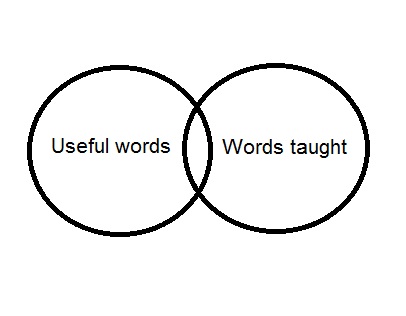
It’s very common to hear somebody say something like “I took Spanish in school, but…” and then proceed to explain how their Spanish language skills are pathetic. How could spending years of time and effort in Spanish classes yield such poor results? The main reason is simple: they learned the wrong words.
To prove this, we offer the following example.
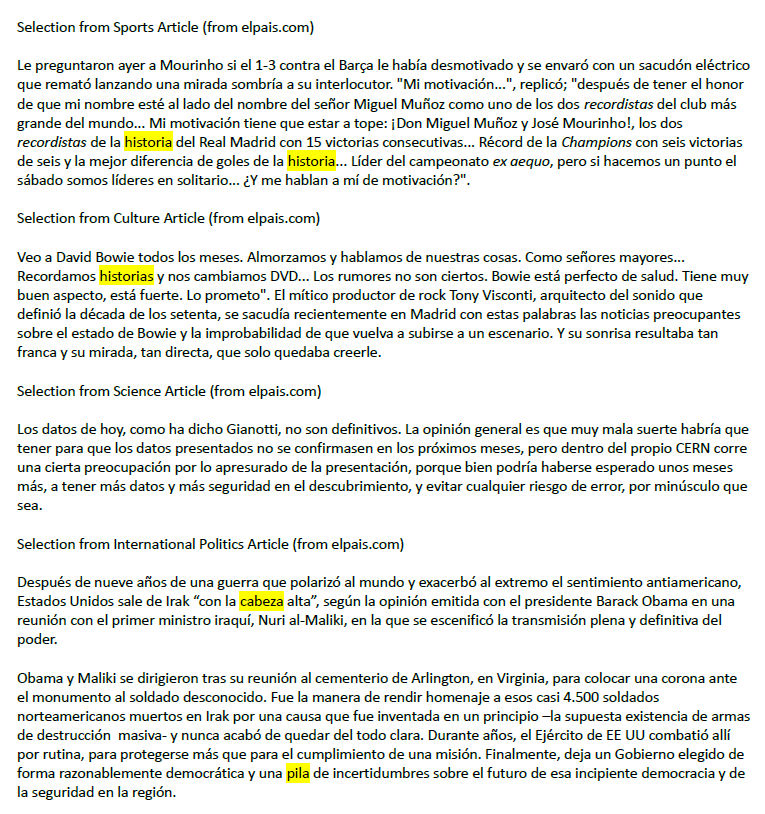
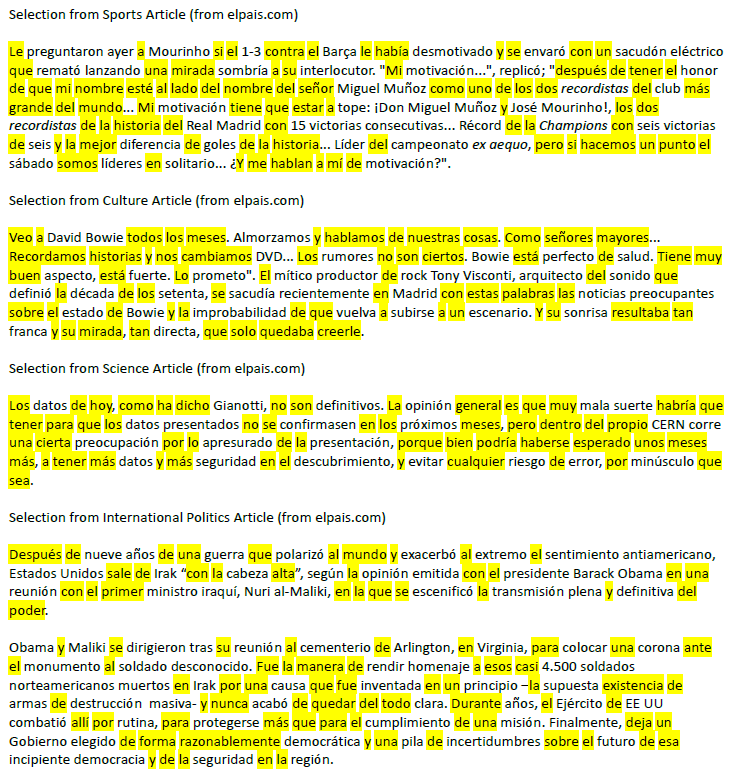
A high-profile and typical language learning company produced a list of 250 Spanish words that they called “Common Vocabulary Words”. We compared it with top 250 words from our high-frequency Spanish words list.
Here are the results.
Top 250 "Common Vocabulary Words"Our top 250 words
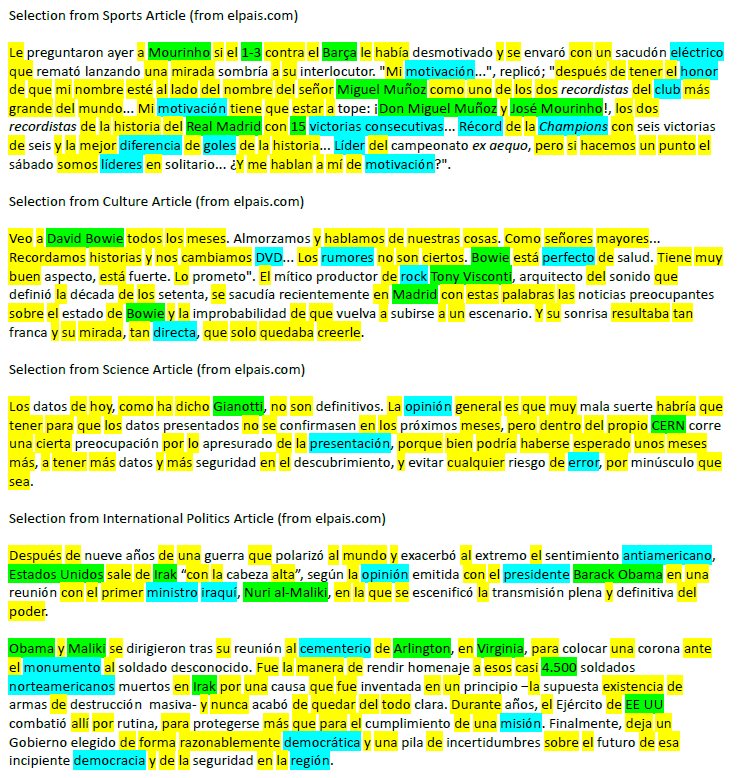
The two images above contain the same text. The text was taken randomly from four different articles in a prestigious Spanish language newspaper. Specifically, the text was taken from articles in the sports section (about soccer), the culture section (about a musician), the science section (about the premier nuclear test facility in Europe), and the international politics section (about US involvement and withdrawal from Iraq).
So what is the highlighting all about? This is where it gets interesting. Every word from the typical “Common Vocabulary Words” list is highlighted in the first image, and every word from our high-frequency word list is highlighted in the second.
This example uses only 250 words! But it gets even better.
The image below has additional highlights for names of people and places [green] and for cognates (words that are spelled exactly the same or very close in English) [blue].
Top 250 words + the obvious stuff
In case it isn’t clear now, I’ll just say it. A high-frequency word list is the best foundational tool for language learning. Period.
It takes time and effort to learn new words. If you spend your time and effort wisely, you can learn the 1% of words that you will run into no matter what your interests are. Language Possible courses are designed to teach that 1% of words first so that you can really enjoy the world that learning a new language will open for you.
Let’s start by identifying what compelling motivation is NOT. “I’ve always kind of wanted to learn a new language” is not a compelling motivation. It won’t make you want to endure massive input. This is where most language learning programs get it wrong. They create fake stories and try to make vocabulary lists about fruits and animals interesting. That’s not compelling or motivating.
What is compelling and motivating is personal. It’s something you’re already interested in. Maybe for you it’s sports. Or maybe it’s cooking or computers or books or travel or architecture or politics or business. The fun starts when you realize that learning a new language can be a part of what you love (and even help you find new interesting things to enjoy).
Instead of telling yourself “It would be cool to know another language”, you should come try learning one today using things you already love as motivation.
Language Possible courses are designed to efficiently teach you the most frequently used words and most crucial concepts of a new language so that you can enjoy the real things you like.
Why do you want to learn a new language? What are you interested in? Share your thoughts in the comments below.
There are so many great reasons to learn Spanish: practical business reasons, curiosity, love of people, cultural exploration, travel, and more. No matter what your motivations are, learning Spanish will benefit you for the rest of your life. Here are some of the best reasons why you should learn Spanish.
Spanish is an important world language
More than 400 million people around the world speak Spanish, making it the second most-frequently spoken language on Earth, behind Chinese and ahead of English (if you count only native speakers). It is an official language on 4 continents, the mother tongue in 21 countries, widely spoken in 21 others, and it is of historical significance worldwide. It is the second most used language in international communication, and an official language of the United Nations and its organizations. One in seven United States citizens and residents speaks Spanish as their primary language, and the Spanish-speaking population of the United States is also growing much faster than the average.
Learning Spanish can help your professional career
While this is true of almost all professions, of course a career in international business, communications, and tourism benefit from new language skills. If you are in healthcare or education, the benefits are also huge. In any case, knowing Spanish will help you communicate with Spanish-speaking employees or co-workers.
Hispanic consumers are the fastest-growing market segment in North America. Their population in the United States grew by 60% in just one decade and their buying power is estimated at over $1 billion. Worldwide, there are around 400 million people who could potentially benefit from the products and services of your business. It certainly wouldn’t hurt to have Spanish on your résumé.
Learning Spanish is relatively easy
Yes you can!
Spanish is one of the easiest foreign languages to learn. The written language is extremely consistent, and there are only 5 vowel sounds (compared to 15 in English!). Many of the Latin root words in Spanish have English counterparts, making vocabulary acquisition much easier.
Learning Spanish can also help you learn other languages. Learning the structure of a language gives you a reference point for learning others. Like making millions of dollars, it gets easier after the first one because you have done it before and have more resources.
Learning Spanish is fun
Ole!
Whether you enjoy listening to new music, watching sports, learning to cook new things, reading famous literature, or just mastering interesting challenges, you’ll find them all in learning Spanish. Learning languages is also its own reward. You’ll find satisfaction and perspective that can only come from understanding other people and their culture.
Learning Spanish will take your travel experiences to the next level
Knowing Spanish can be the difference between a getaway and an adventure. It’s not just about being able to read the menu, either. It’s about getting outside of a hotel or resort and actually connecting with interesting people and experiences. Do you want to observe the world, or participate in it? It can even help you make the world a better place. Knowing Spanish can empower you to make a difference in the lives of people around the world.
Learning Spanish will make you smarter
Many English words came from Latin by way of French. Since Spanish is also a Latin language, you will increase your understanding of English vocabulary as you study it. Students who learn another language also score higher on tests in all subjects, especially Math and English. Not only that, it actually gives both children and adults improved critical thinking skills and creativity.
Does this mean that listening to German music will help you learn German, even if you have no clue what the words mean? Yes! In fact, exposure to new sounds actually makes the language part of your brain grow, just like exposure to stress makes your muscles grow.
Does this mean that listening to German music will help you learn German, even if you have no clue what the words mean? Yes!
This doesn’t mean that you should never think about what you hear or read in another language, though. To take full advantage of input, you should train your brain to notice and remember language patterns. Your brain will develop its own rules for how the language works as you listen to it, but you can streamline that process and avoid a lot of misunderstanding if you review the rules of a language as you go. The more attentive you are to the patterns of a language, the more you will notice and remember.
Not all input is created equal. The best input is meaningful input. By meaningful, I mean both understandable and interesting. We learn best from content that matters to us, so find something you actually like to read or listen to. In short, do things you like. Emotion is a powerful memory catalyst, and positive emotions are the best.
The best input is meaningful input. By meaningful, I mean both understandable and interesting. … Emotion is a powerful memory catalyst, and positive emotions are the best.
You can also increase the effectiveness of any input if you combine audio with text (notice I said text, not pictures) whenever possible. Read out loud. Read the lyrics to a song as you listen to it. Write what you hear and compare it with a transcript. You will find that your brain remembers better if it hears, sees, processes, and produces audio and text together.
How do people really learn their first language? We don’t know everything about how infants learn their first language, but there are a couple of things we do know for sure. Beyond these, all we can really say is that people construct understanding from experience.
Second, they have very compelling reasons to learn a language (e.g.: survival). You could even say that they don’t have any other option but to learn it.
These two factors (massive input and compelling motivation) are not only a part of learning a language, they will determine whether or not it happens at all.
These two factors (massive input and compelling motivation) are not only a part of learning a language, they will determine whether or not it happens at all.
You may have heard people claim that learning a language is easy for young children. It’s not true. Learning a language requires a tremendous amount of focus and practice at any age. So what does that mean for adults? Can they learn a second language “the same way they learned their first language”? My answer: only if they have compelling motivation that makes them want to endure massive input.
For some people, their curiosity provides enough motivation to learn a new language. Others may have external circumstances that make learning a new language a necessity (like immigration). But you don’t have to fit into one of those two categories to have success learning a language.
The trick is to use existing interests to motivate yourself. You don’t have to focus your energy on learning to parrot dialogues, memorizing different names for all of the countries in the world, or endlessly conjugating irregular verbs in the pluperfect. You should do things you already enjoy, like: listening to music, watching movies, reading books, and talking to real people.
So where do language learning programs fit in all of this? Well, the only ones worth your time are the ones that help you get the most out of the music, movies, books, and relationships that you really want to enjoy. That is why Language Possible courses are designed to prepare you for authentic experiences and make sure you get the most out of them.
The Spanish Rulebook is a result of years of rigorous and extensive research in Spanish language instruction. This comprehensive reference is a must-have for any serious student of the Spanish language.
The Spanish Rulebook is really three books in one: pronunciation guide, grammar and verb resource, and usage manual. It is the perfect reference for any Spanish language student.
[button link=”http://www.mediafire.com/file/w9j2jzbapjvttph/Spanish%20Rulebook.pdf”]Click here to download the Spanish Rulebook for free![/button]
Over 1000 authentic, embedded audio examples of Spanish used in context Clear and concise definitions for even the most complex linguistic concepts Detailed grammatical constructions with charts, examples, and exceptions Helpful usage advice with real-life examples Precise and easy-to-use pronunciation guide Unique and practical “Real Spanish” guide to understanding Spanish the way people really speak it Generous coverage of common dialect differences including Castellano and Rioplatense Much, much more
Learning a language is like learning a new sport: you have to train your mind and body to perform new skills. Some people may have natural talents, but what separates superior athletes and linguists is simply this: training and practice.
The first step is quality training. The right perspective and solid, engaging teaching methods can make the complex seem simple and the confusing seem natural. Just like in athletics, the right coaching can make all the difference.
Then comes the practice. Some people say that practice makes perfect. The truth is that perfect practice makes perfect. Practicing something wrong will only reinforce bad habits.
Learning languages is like learning a new sport: you have to train your mind and body to perform new skills.
The team at Language Possible helps you practice in ways that are real, relevant, and rewarding. We want you to practice the most important things the right way and enjoy the experience.
Learning and practicing fundamentals is important, but if you aren’t practicing with the goal in mind of participating in the real thing, practice seems boring and pointless. Can you imagine a sports training program that only allowed people to experience a real game after years of practicing simple, isolated tasks?
At Language Possible, we believe that you should experience authentic language from day one. Things like songs and movies are a great way to be immersed in and entertained by authentic language at the same time. It’s not only the best way to stay interested, it’s the best way to learn. That is why our courses are designed to provide you with the tools and confidence to dive into all of the interesting things that made you want to learn the language in the first place.
When we tell people that Language Possible courses help people enjoy learning a language as quickly as possible, they sometimes ask our opinion of Rosetta Stone. Here are a few reasons why we don’t like Rosetta Stone.
Reason #1: Their claims are just foolish oversimplifications.
Beware the marketing machine.
When you actually think about what their commercials say, you can clearly see they are just a full of meaningless marketing phrases. For example…
“No translation.” 92.4% of Rosetta Stone exercises use the old Direct Translation method, according to the research of the University of Maryland Center for Advanced Study of Language.
“No memorization.” You mean people aren’t even supposed to remember it? What could be easier? Which brings us to…
“Easy” is an empty claim. It’s “easy” because you don’t even know when or why you don’t understand it. Therefore, you can feel like you are learning very…
“Fast” But fast compared to what? Actually understanding authentic content?
“Interactive” – Oh, you mean you can click on one of four pictures to hear vague words and phrases that are never explained? Really? Big deal. Books are interactive, too. They have instructions and you can turn to any page whenever you want.
“Start speaking from day one.” Wow! You mean you can learn to say at least one word right away? You can bet that’s something nobody else is willing to claim.
“Teaches you to think in a new language.” What does that even mean? Rosetta Stone’s programs don’t give meaningful feedback or explain anything at all. It just conditions you to feel good when you get a lucky guess and hear a bell. Cheese-ball game show antics might feel “fun” at first, but all they teach is how to play the cheese-ball game, and that gets boring very quickly. You can guess your way through Rosetta Stone programs using nothing but visual clues and a simple process of elimination. Fun? Try repetitive and tedious.
“Natural…the way you learned your native language.” Your first language took years to learn. Are they suggesting that you really only listen to the language for a year or so, then start babbling, then actually form words, then learn about how words can be written down, then go through years of understanding general grammar concepts again? Language isn’t just about learning a list of words, anyway. Why pretend to ignore everything you already know about language and start from scratch?
Reason #2: What they call their “Dynamic Immersion” method is complete hogwash.
Real dynamic immersion would be seeking out lots of authentic experiences. Looking at vague, culturally irrelevant, reusable stock images doesn’t immerse you in anything but marketing collateral.
Don’t believe me? You should read what the University of Maryland Center for Advanced Study of Language said after their in-depth empirical study of Rosetta Stone for US Government use. In their article entitled Rosetta Stone Version 3 Falls Short of Manufacturer’s Claims, they claim that “Rosetta Stone is unlikely to be the solution to the U.S. Government’s language learning needs.” They also say that “Rosetta Stone’s claims about the innovativeness of the product, as well as the language learning outcomes possible after its use, are generally overstated. The software does not provide the dynamic environment required to practice using the language in context.”
Reason#3: Writing systems are basically ignored.
It's all Greek to them.
Information about how a language’s writing system works are not provided. Users are expected to figure that out on their own. Ignoring written language is a huge disservice to language learners – especially when learning a language that has a completely different writing system. This is not just poor-effort instructional design, it’s a deliberate omission of crucial language information.
Reason #4: It teaches the wrong words.
Learning to say "the aqua aardvark" will not likely come in handy on your next trip.
In this respect, they are much like other language programs in that they group categories of words together (like colors and animals) and then drill you on them, rather than teaching you the most commonly used words and phrases first so that you can rapidly access authentic materials that are actually interesting to you.
Reason #5: It treats all languages equally.
Rosetta Stone courses are all essentially the same. When your whole approach to learning languages can be boiled down to glorified flash cards, it’s no wonder they were able to stamp them out for 30-some-odd different languages. Cookie cutter production methods cause all sorts of confusion, especially when combined with the “you have to guess what we mean” approach.
One simple example of the “you have to guess what we mean” approach: People in Spanish don’t say “I’m X years old”, they say “I have X years” (Tengo X años). When left to your own devices, you might think that the word tengo means “I am”, and that años means “old”. To further the example, people in Arabic would say “My age is X years.” There are thousands of similar situations in all languages.
Reason #6: Their speech recognition technology is misleading.
Ooh, technology!
At first glance, seeing waveform representations of audio may seem magical to the novice. However, they do not help your pronunciation. They are simply visual marketing tools to make people think that talking to computers will help you talk to people. To improve your accent, you first need to learn to hear the difference between the mistakes you are likely to make and authentic pronunciation. Rosetta Stone software does not teach the difference, and their speech recognition technology can’t reliably tell the difference.
Reason #7: It is way too expensive.
All that money for flash cards on a CD? At least they come in a shiny yellow box!
I could go on and on about other things like: it is too slow, it is based on observation rather than communication, it is all multiple choice, it is unclear, and it is confusing. But I think you get my point. Rosetta Stone is not a language learning company, they are a marketing company. What the world can learn from them is how to sell yellow boxes, not how to teach people a new language.
So you want to learn a new language? Click here to see why Language Possible makes the best language learning materials on the planet, or just click here to try it out for yourself!